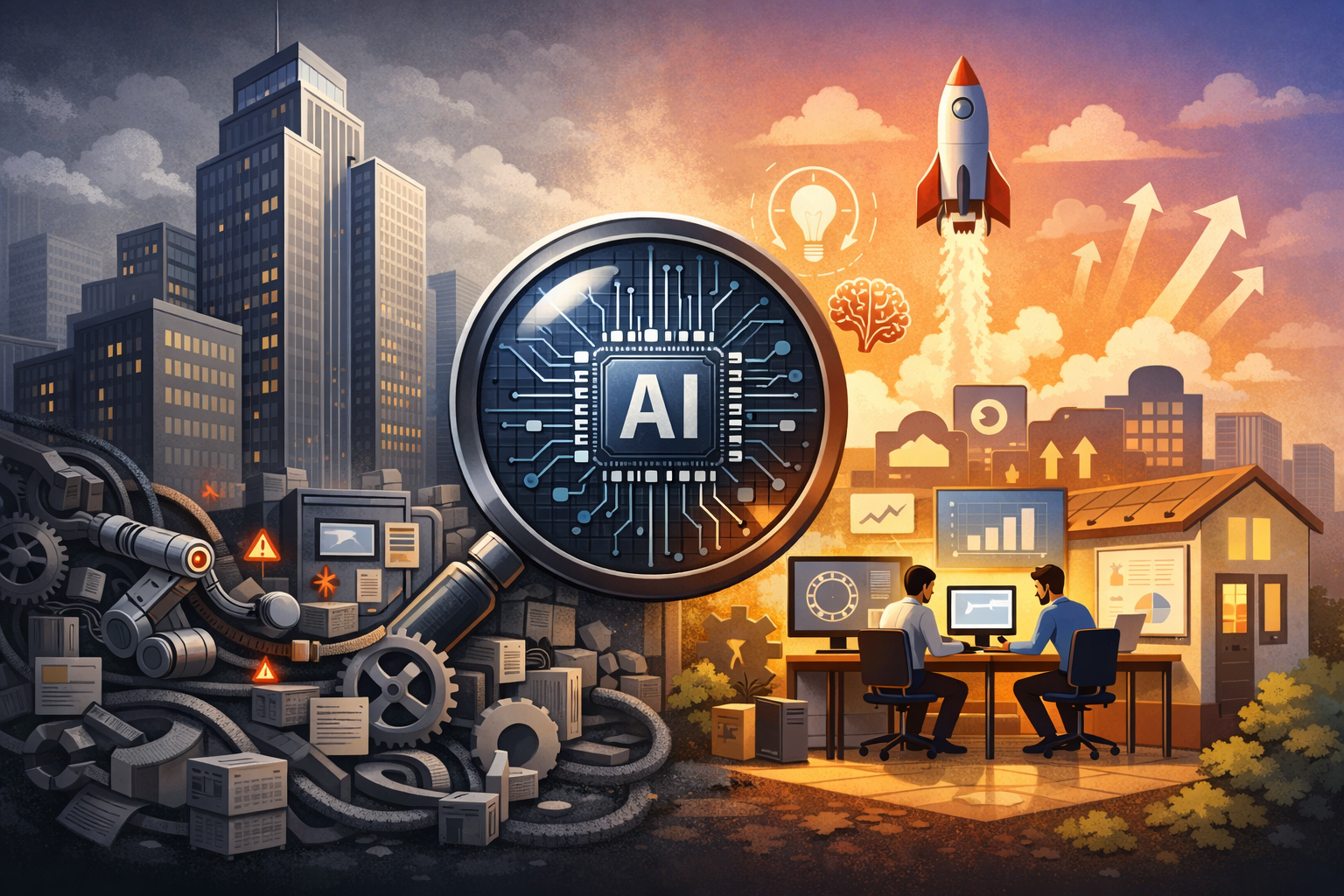
From hype to hesitation: how we designed the corporate attitudes to AI block

While technological infrastructure and strategic planning are often highlighted as the main drivers of artificial intelligence adoption, they represent only part of a much broader picture. Equally important—but frequently underestimated—are corporate attitudes, perceptions, and cultural orientations toward AI. Understanding how organizations feel about artificial intelligence, and how they interpret its potential risks and benefits, is critical to explaining why some companies move forward decisively while others remain hesitant.
This section of the research therefore focused specifically on exploring corporate perceptions of AI. Its core assumption was clear: successful AI adoption does not depend solely on tools, data, or budgets, but also on whether organizations perceive AI as an opportunity for growth or as a disruptive threat to stability and employment.
Measuring Corporate Attitudes Toward Artificial Intelligence
To capture these nuances, respondents were introduced to the section with the instruction:
“To what extent do you agree or disagree with the following statements about your company’s attitude toward AI?”
Participants evaluated each statement using a five-point Likert scale, ranging from 1 – Strongly disagree to 5 – Strongly agree. This approach made it possible to identify not only clear supporters or opponents of AI, but also more subtle positions in between—such as cautious optimism, conditional support, or latent skepticism.
Rather than forcing binary answers, the scale allowed the research to reflect the reality of organizational decision-making, where attitudes toward AI often evolve gradually and are shaped by uncertainty, prior experience, and internal capabilities.
AI as a Strategic Priority—or a Distant Consideration
One of the key dimensions examined was the extent to which enterprises perceive AI as a strategic priority. This included assessing whether companies explicitly plan to invest in AI-related development, innovation, or integration into core business processes.
By linking declared attitudes with actual strategic intent, this dimension helped distinguish between organizations that merely acknowledge AI’s importance in abstract terms and those that demonstrate a tangible commitment to its adoption. In many cases, positive attitudes toward AI did not automatically translate into concrete investment plans, highlighting a gap between recognition and execution.
This finding reinforces the idea that strategic alignment is not just about technology roadmaps, but also about managerial conviction and long-term vision.
Employment Concerns and the Social Dimension of AI Adoption
Another critical aspect explored in this section was concern about the potential impact of AI on employment. These questions addressed one of the most sensitive and debated issues surrounding artificial intelligence: whether it is perceived as a tool for workforce augmentation or as a driver of job displacement.
Responses in this area revealed significant variation in corporate sentiment. Some organizations expressed confidence that AI would enhance productivity and free employees from routine tasks, while others demonstrated a more cautious or even defensive stance, reflecting fears about workforce reduction and social consequences.
These perceptions are particularly important, as they shape internal communication, change management strategies, and employee acceptance of AI-driven initiatives. Organizations that approach AI primarily through a lens of risk may struggle to mobilize internal support, even when technological readiness is high.
Investing in People: Training and Capability Building
The third major dimension focused on support for employee training and capacity building in the AI domain. This element reflects an increasingly recognized reality: human capital readiness is one of the decisive factors for successful AI implementation.
Organizations that actively support upskilling and reskilling signal a long-term, sustainable approach to AI adoption. Rather than treating AI as a purely technical upgrade, they acknowledge the need to develop internal competencies, foster interdisciplinary collaboration, and build trust in new systems.
Conversely, limited emphasis on training often correlates with uncertainty or ambivalence toward AI, suggesting that the technology is seen as externally driven rather than strategically embedded.
Why Corporate Perception Matters
Taken together, this section provides valuable insight into the motivational and perceptual context in which AI implementation takes place. It complements the structural and strategic perspectives examined in earlier parts of the research by highlighting that AI adoption is ultimately a socio-technical process.
Even the most advanced technologies can fail to deliver value if organizational culture, leadership attitudes, and employee perceptions are misaligned. Understanding how companies perceive AI—whether as a necessity, an opportunity, or a threat—helps explain divergent adoption trajectories and sheds light on the deeper dynamics of digital transformation.
As AI continues to reshape business landscapes, these perceptual factors may prove just as decisive as investment levels or data availability in determining who leads, who follows, and who is left behind.
Follow AI-ImpactSK on LinkedIn
Author(s):
Ing. Federico Banda (federico.banda@euba.sk)
Bratislava University of Economics and Business
Faculty of Business Management.