
Start Small, Start Now: Five Field-Tested AI Recommendations for Slovak Businesses
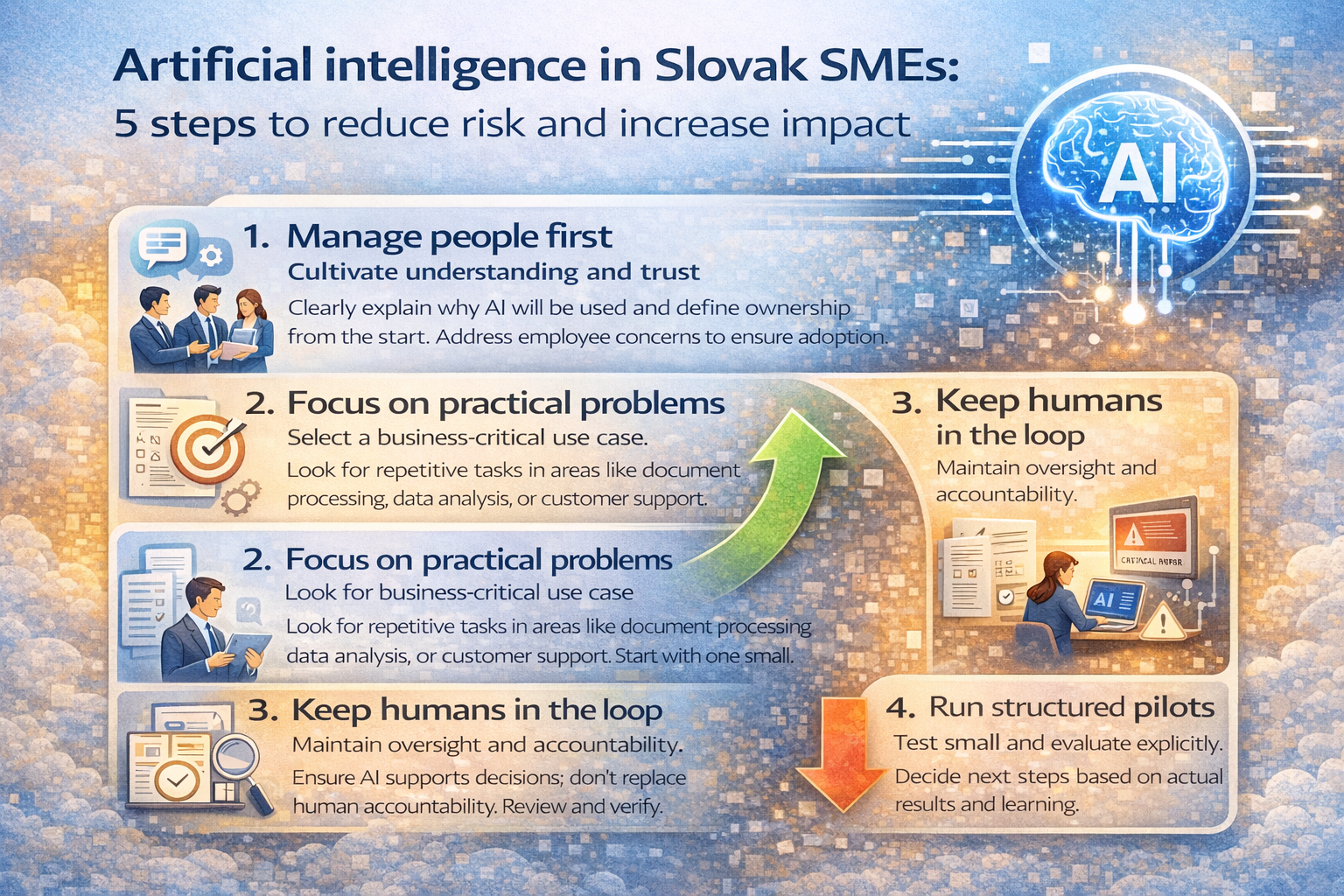
Artificial intelligence is no longer an abstract concept for Slovak companies. Increasingly, owners, CEOs, CFOs and senior managers of small and medium-sized enterprises are exploring how AI can improve their operations.
At the same time, many remain cautious. Slovak SMEs operate with limited internal capacity, tight schedules and strong pressure to deliver practical results. In such an environment, ambitious narratives about “AI transformation” often feel disconnected from everyday business reality.
Insights from in-depth interviews with Slovak companies suggest a different approach. Successful organisations rarely begin with large transformation programmes. Instead, they start with a clearly defined business problem, test a manageable pilot, and build experience step by step.
The guiding principle is simple: start small, but start now.
The recommendations below translate the lessons from real AI implementations into five practical moves that Slovak SMEs can adopt without taking unnecessary risks.
Manage people first: communication determines adoption
In many AI initiatives, technology receives most of the attention. Yet interviews with Slovak companies consistently highlight another factor: communication.
AI projects often stall not because of technical limitations, but because employees do not understand their purpose or fear potential consequences.
If staff perceive AI as a threat to their roles, or managers see it as a black box they cannot control, even well-designed technical solutions will remain underused.
For SME leaders, this means focusing on three priorities:
- Explain the business purpose. Clearly communicate which process you want to improve and why — whether the goal is reducing costs, improving quality, or enabling innovation.
- Define ownership. Assign clear responsibility for both the business outcome and the technical implementation of the project.
- Involve end users early. Pilot phases should include feedback from employees who will ultimately use the system.
AI adoption is as much a communication challenge as it is a technological one.
Focus on high-value problems, not AI for its own sake
AI should never be introduced simply because it is fashionable. The most successful companies begin by identifying a specific operational challenge.
In the research interviews, organisations were asked whether AI targeted a core business process or a support process, and whether the priority was cost savings, higher quality, or innovation. This framework ensures that AI initiatives remain anchored in business value.
For Slovak SMEs, a practical starting point is to examine a small set of candidate processes.
Look for activities that:
- involve repetitive manual work
- require frequent document processing or data analysis
- suffer from delays, errors or bottlenecks
Once potential opportunities are identified, select one high-value problem where even a modest improvement would have visible impact on costs, revenue, quality, or risk.
AI should solve real problems — not create new ones.
Keep humans in the loop
AI systems should support decision-making, not replace accountability.
Generative AI tools in particular can sometimes produce outputs that sound convincing but are factually incorrect. Without appropriate oversight, such errors may create operational or reputational risks.
Companies interviewed in the research emphasised the importance of maintaining human supervision throughout AI workflows.
Practical steps include:
- Introduce human checkpoints. AI can prepare drafts, classifications or recommendations, but final decisions should remain with domain experts.
- Clarify responsibilities. Define which tasks remain fully human, which are AI-assisted, and who has the final authority in case of disagreement.
- Monitor both benefits and errors. Track time savings and productivity gains, but also analyse mistakes in order to improve prompts, rules and processes.
Human oversight ensures that AI remains a reliable tool rather than an uncontrolled system.
Run structured pilots before scaling
Successful companies rarely deploy AI solutions across their organisation immediately. Instead, they treat early projects as controlled experiments.
Interviews reveal a common implementation pattern: organisations begin with a pilot phase, evaluate the results using clearly defined KPIs, and only then decide whether to expand the solution.
For Slovak SMEs, a structured pilot approach can significantly reduce risk.
Key elements include:
- Define a limited timeframe. A pilot may last several weeks or a few months depending on the process.
- Set a small number of clear KPIs. Examples include reduced manual processing time, fewer reporting errors, or faster response times to customers.
- Test in realistic conditions. Use real data or a small group of users to observe how the system behaves in practice.
- Evaluate the results explicitly. At the end of the pilot, decide whether to scale the solution, adjust it, or discontinue it.
Treating AI projects as experiments allows organisations to learn quickly while limiting exposure.
Choose tools and partners deliberately
Technology selection is not only a technical decision — it is a strategic one.
In the research interviews, companies explained why they selected specific technologies such as generative AI, predictive analytics, natural language processing or computer vision. They also described how they chose between ready-made solutions, open-source tools, or custom development.
Several criteria consistently appeared in these decisions:
- price and implementation cost
- compatibility with existing systems
- flexibility and scalability
- security and data protection
For SMEs in particular, the choice of external partners can strongly influence the success of an AI project.
Before committing to a technology or vendor, companies should clarify:
- who will be responsible for technical integration
- who will ensure the business outcome
- how support and maintenance will work after deployment
Whenever possible, contracts should include an initial pilot phase with clear KPIs before scaling the solution further.
From research insights to practical action
The recommendations above are grounded in real AI initiatives implemented by Slovak companies. The interviews examined which processes organisations chose, what priorities guided their decisions, which technologies they adopted, and how they measured success.
Across these experiences, a consistent message emerges.
Successful AI adoption in Slovak SMEs typically follows a pragmatic path:
- start with a concrete business problem
- prioritise communication and ownership
- maintain human oversight
- test solutions through structured pilots
- choose tools and partners carefully
This approach transforms AI from an abstract technological concept into a practical operational tool.
Turning recommendations into action
Even with clear guidance, many SME leaders remain cautious about starting with AI. Concerns about choosing the wrong use case, overloading already busy teams, or investing in unused tools are entirely understandable.
The key is not to solve everything at once.
The safest path forward is to identify one high-value process, design a small but well-structured pilot, and build experience step by step.
In spring 2026, the AI-ImpactSK team will launch an educational programme designed specifically for Slovak businesses that want to move from experimentation to practical AI implementation.
Follow AI-ImpactSK on LinkedIn for updates and upcoming events.
Author(s):
doc. Ing. Nora Grisáková, PhD. (nora.grisakova@euba.sk)
Bratislava University of Economics and Business
Faculty of Business Management


